Case Study: 100% in A Level Art - Moving Image
Last Updated on January 5, 2022
As engineering science changes, a growing number of students are exploring moving image every bit part of their loftier school Art courses. This is a new area for many Art Departments and it tin exist unclear how to all-time approach this. We are delighted to share the work of A Level Art and Design student Charlotte Cook, who gained 100% (A*) while studying at Southward Hunsley Schoolhouse, Due north Ferriby, United Kingdom.
Ane of Charlotte's sketchbook pages is included in our new book: Outstanding Loftier School Sketchbooks . This book has high-resolution images so that fine details and notation are clear, making it an excellent resource for students and schools. Learn more!

Charlotte began A2 Art and Design with an first-class runway record: A* in GCSE Art and 100% in AS Level Art and Design (AQA). Although she had no experience with film-making and knew no other students who had specialised in this area, she understood that a moving prototype project must include the same development process, artful qualities and technical skill as a traditional fine art project. We interviewed Charlotte about her A2 Coursework projection: her answers illuminate the learning bend that is required and highlight the similarities and differences betwixt a moving image and traditional Fine Fine art project.

What drew you towards creating a film-based Art project?
Charlotte: As this was my final unit of measurement, I wanted to bring together everything I had explored over the two years – maybe like a conclusion. I wanted to face a challenging and mature projection, both skill-wise and intellectually; this I take found to be a staple to all my favourite and successful work – especially when I am pushed to the limit!
During GCSE I had unveiled an affinity with Photography, which chop-chop became an important element for my creative process, alongside more traditional inking. I enjoyed having something digital to express abstract ideas, and I actually similar working on the reckoner.
Nevertheless, lower-downwardly schoolhouse, it had never occurred to me that information technology was possible to work in a film format, it had e'er seemed beyond me, and I did not come across how it would chronicle to my piece of work. Additionally, none of the students I knew had always used moving picture either, making it an intimidating medium to arroyo. Therefore, wanting a challenge, and beingness inspired past various artists (Kara Walker, Tejal Shah, Daria Martin…) film became the cadre of this project.

How did you plan, express and develop ideas through moving image and how did this differ from your earlier Fine art projects?
Charlotte: Similar other projects, I used a sketchbook. All the same, the interaction with my sketchbook differed greatly.
I wrote more than, and illustrated more 'moments'.
I call back this is because I institute information technology easier to rapidly sketch a composition so write lots about the sound and movement – sound being incredibly more than of import than I had thought! Sometimes I would focus on the audio every bit a carve up element, and then unify it with the visuals after.

Sculpting 'props' is something which film encouraged. As I would be filming in a three-dimensional space, three-dimensional objects were suitable – perhaps it is like making a collage of the infinite.
Within my sketchbook, I would accept vague ideas of 'moments' and of the structure, thinking of the imagery, and of what I wanted to achieve. I would film equally much every bit I could, and shoot things in different ways, trying out various lighting and angles, like when working with Photography. The rest of the development would happen digitally, and outside of the sketchbook. Thus, my sketchbook was used more for documenting this development and reflecting on what I had produced and how I could refine my ideas further.
Post-production was the most important element for my projection, and this is how my ideas were realised. I would keep in mind what I wanted to portray and then experiment! Splicing footage together, breaking visuals from sound and merging information technology back in various ways. Exercise keep in mind that, similar on other digital software, you work in layers, and footage can be superimposed. Inside the software I would organise things on a timeline, and almost brand patterns on this. Layering sound and leaving space.
Compared to other projects, I feel this had then much more complexity to it, which meant there was a lot of planning.
Which programmes and tools did you use to create your projects?
Charlotte:
- Photographic camera: Nikon D3100 with AF-S VR DX xviii-55mm lens (available from Amazon Britain and Amazon.com – affiliate links)
- Editing software: Adobe Premiere Pro CS6
I used my photographic camera for the footage, and for recording sound.
I would recommend having VCL Media Thespian installed. Yous can deinterlace, crop, covert videos, have snapshots from footage etc. It was really useful!
Similar to painting for the commencement time, or working with Photography, information technology is nigh experimenting and trying out new things. Sometimes I would see other artists and filmmaker do something and I would want to employ it for my ain work. I would then look online for tutorials and encounter what could produce similar effects.
It took more fourth dimension and effort compared to other projects I have done earlier. Information technology is common to detect strange things happening while you lot are trying to edit and having to read through 5 articles to notice out what is going on. All the same, these unexpected occurrences can be interesting also; it is all part of the creative procedure.

What communication do you lot accept for other loftier school Art students who desire to complete a digital moving image / picture show based project?
Charlotte:
- Definitely try to bear your camera everywhere – use it like a sketchbook – capturing visuals and sound
- I really liked collecting unlike sound samples when I went for walks
- Back up your work and save lots of different copies, you exercise not want yourself saving over the same file and making a strange mistake that y'all cannot get rid of!
- Try getting your easily on a tripod. This will go far easier to go footage in darker places and make your work await more professional and sophisticated
- Do utilize your sketchbook and look at other moving-picture show artists
Even though I worked through the computer, film tin can be less digital if you want it to be and there are lots of different ways of creating moving prototype, for example stop-motion animation.
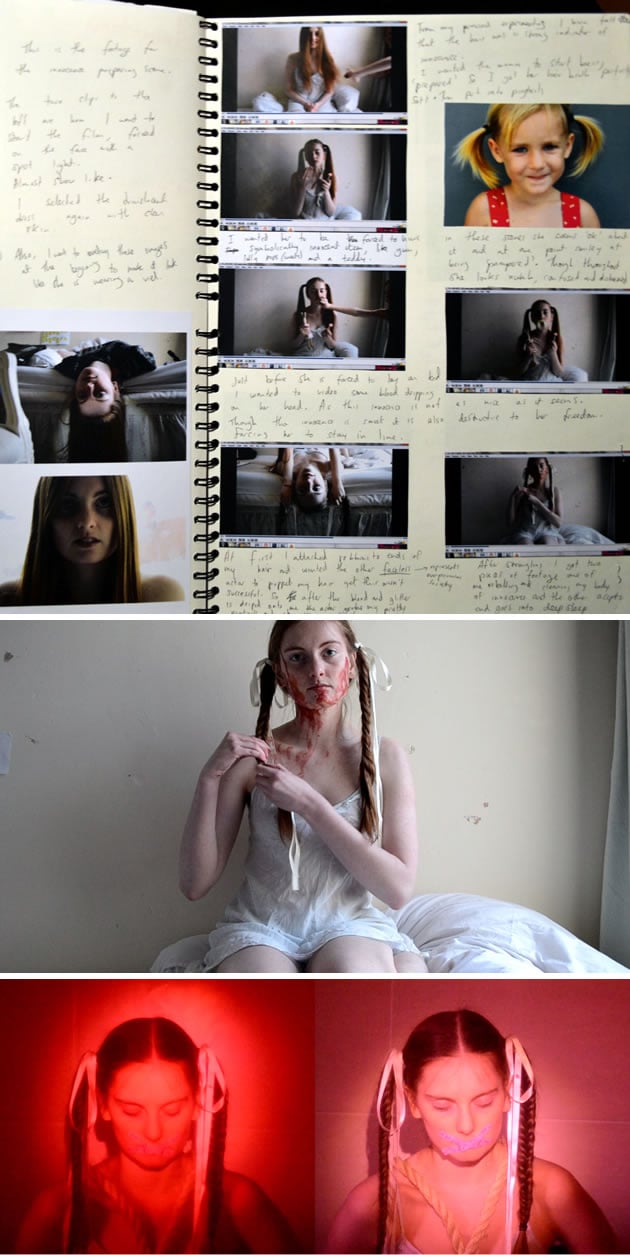
If you wish to see more of Charlotte's piece of work, please view her A* GCSE Art project!

Amiria has been an Art & Design teacher and a Curriculum Co-ordinator for 7 years, responsible for the course blueprint and assessment of educatee piece of work in two high-achieving Auckland schools. She has a Bachelor of Architectural Studies, Bachelor of Architecture (Get-go Class Honours) and a Graduate Diploma of Teaching. Amiria is a CIE Accredited Art & Design Coursework Assessor.
Source: https://www.studentartguide.com/featured/moving-image-a-level-art
0 Response to "Case Study: 100% in A Level Art - Moving Image"
Post a Comment